
We speak to Plunkett’s Impact Officer, George Ogier, who shares more about his first year in the role.
You have previously spent two years as Plunkett’s Project Support Officer. What inspired you to move into the impact side of community businesses?
I’ve lived with cerebral palsy since birth, and some of my work before joining Plunkett focused on advocating for people living with disabilities and understanding the wider social issues affecting them. My role as Project Support Officer gave me a brilliant grounding in building relationships with community businesses. I was often their first point of contact – talking through early stage ideas, helping them access Plunkett’s support, and getting a real feel for what they were trying to achieve. Those relationships were invaluable when shaping the Impact Officer role, which allows me to dig deeper into the social impact that makes the community owned model so vital for rural communities across the UK.
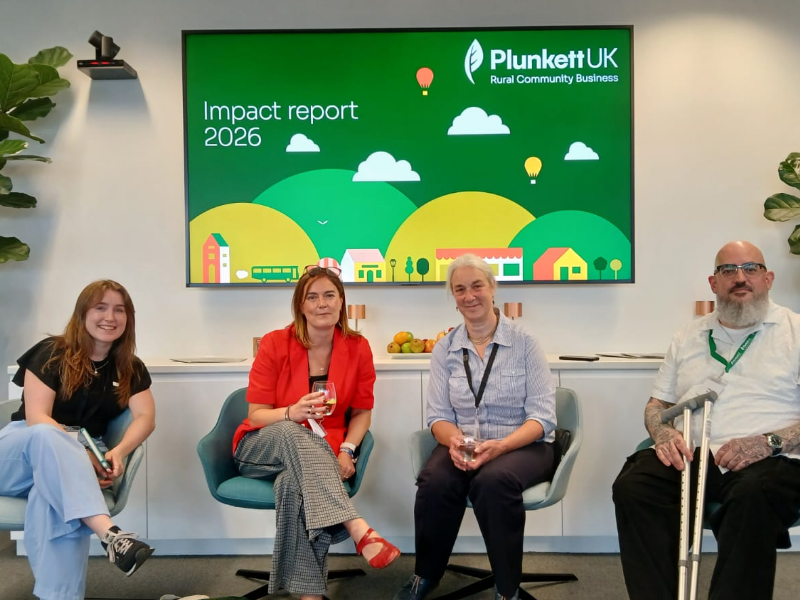
George at the launch of the 2026 Impact Report, alongside Jessica Craig (Power to Change), Amanda Reynolds (Six Bells Peterstone), and Rosie Plummer (Dryslwyn Community Shop)

Menter y Glan
What have you learned from your first year in the role?
A key learning curve has been around diversity in rural communities. Many community businesses understandably feel their areas lack diversity, but through the EDI Special Interest Groups we explored hidden forms of diversity such as single parent families, refugees, ex forces personnel, or young adults leaving the care system. Understanding these less visible experiences has been incredibly valuable and has broadened my perspective on what inclusion really looks like in rural settings.
The environmental side of the role has also been a highlight. It’s an area people often feel more familiar with, and I’ve enjoyed discovering the range of initiatives community businesses are leading – from EV charging points and solar panels to community gardens, orchards, and nature based social prescribing. Hearing how these projects support wellbeing and strengthen local resilience has been genuinely inspiring. Overall, the year has been full of learning, growth, and a deeper appreciation of the impact community owned businesses have across the UK.
From your external visits you have made so far, what has stood out that community businesses can learn from?
One thing that really stands out is that much like fingerprints, every community owned business is unique. There’s no one size fits all approach, and my external visits have reinforced how valuable it is to learn from a wide range of organisations and the different ways they support their communities.
A great example is The Branch in Chipping Norton. They work to tackle rural digital exclusion by supporting people who aren’t online to ensure their voices are still heard. When a local council survey was only available digitally, volunteers sat with people one to one to help them take part. Their work goes far beyond digital access: they run cooking sessions to address food poverty, support families and refugees, and even ensure a Ukrainian speaker is present during drop ins. It’s a brilliant example of meeting people where they are.
Visits further afield have been equally inspiring. At the DTAS event, I met a charity called Verture, who specialise in climate adaptation by helping communities prepare for hotter summers, wetter winters, and the realities of climate change. We’ve since brought them into our Special Interest Groups, giving community businesses practical tools to face future challenges.
These visits and insights show how much community businesses can gain from wider partnerships and how powerful shared learning can be.
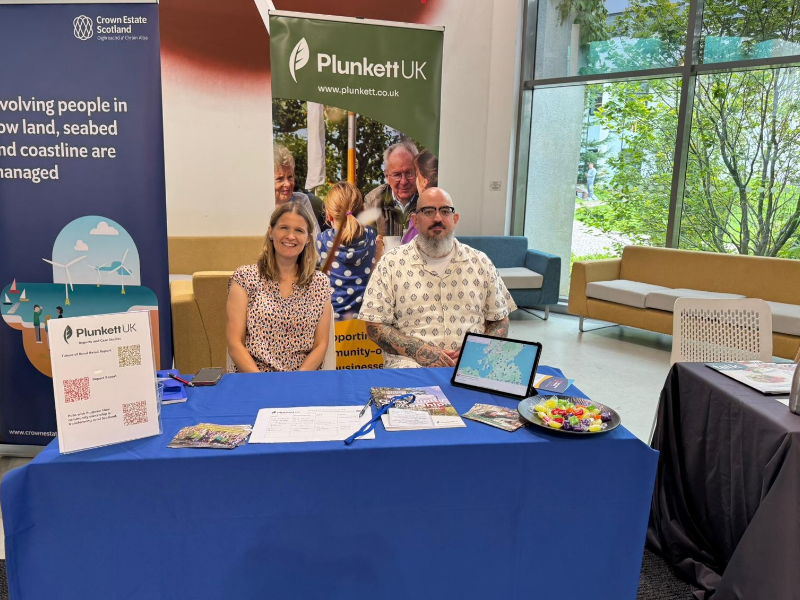
At DTAS Conference 2025

Volunteers at Westbury Community Shop & Cafe (Buckinghamshire)
What message would you share to community businesses about recognising and valuing their impact?
What strikes me is that many community businesses don’t always realise the scale of the impact they already create. Simply by existing, a community owned business makes a difference – through essential services, local employment, volunteering, and the sense of belonging they foster. These are all things Plunkett values deeply, and they sit at the core of what makes the community owned model so powerful.
We call them “community owned businesses,” but in many ways they operate more like community services, offering far more than a traditional business could. And they do this despite rising costs, pressures on hospitality, and challenges sourcing stock.
Yet even in tough times, they continue to go above and beyond for their communities. I’m incredibly passionate about helping them recognise just how special and important they are. Their impact is real, it’s meaningful, and it deserves to be celebrated.
Find out more about our areas of impact
Download our latest Impact Report, which is packed with statistics and real-life stories showing how community-owned initiatives are transforming lives across the UK.
Want to get involved?
Visit our Upcoming Events Page to stay up to date with upcoming sessions designed to support and inspire everyone involved in community-owned businesses.