
With the English Devolution and Community Empowerment Bill receiving Royal Assent yesterday (29 April), Plunkett UK’s Chief Executive James Alcock reflects on how the passing of strengthened Community Right to Buy legislation marks a hugely significant moment for communities across England.
We, at Plunkett UK, warmly welcome this progress and congratulate the Government on taking this important step forward.
This moment also offers an opportunity to reflect on how far we’ve come.
Back in 2011, when the original Assets of Community Value (ACV) legislation was introduced, it represented a breakthrough. It gave communities, for the first time, a formal mechanism to pause the sale of valued local assets and organise themselves to bid for them.
That legislation did not emerge in isolation. It was shaped in no small part by the efforts of committed individuals across the sector – including former colleagues at Plunkett – who recognised the potential of community ownership and worked tirelessly to make the case for change.
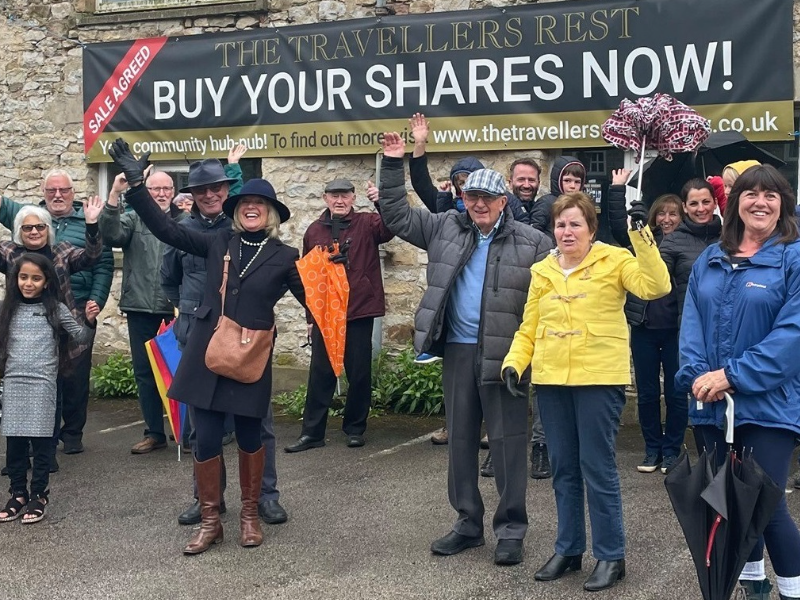
Some community members in Skeeby, North Yorkshire celebrate saving their pub under community ownership in 2022, reopening a year later.
A collective effort to strengthen the framework
On a personal note, I want to recognise the contribution of two individuals from Plunkett who played a pivotal role in this journey. Mike Perry was instrumental in shaping the original 2011 legislation, helping to design its framework and build the evidence base that demonstrated the need for community rights in the first place. More recently, Chris Cowcher has continued that work – working closely with communities facing stalled or challenging situations, and helping to push for the strengthening of the legislation we are now seeing come into effect. Their contribution, alongside many others, has been vital.
It was also shaped by real community campaigns. In places like Skeeby in North Yorkshire, local people came together to try to protect their village pub, The Travellers Rest. Their journey highlights both the strength of community determination and the limitations of the tools available at the time. Following its closure in 2008, the community spent 14 years working to bring the building into community ownership, followed by a further year of refurbishment before reopening in 2023. In effect, an entire generation went without access to what had been a vital local service.
Cases like this helped bring national attention to the challenges communities faced when valued assets were at risk, particularly in the absence of effective legislative tools – or where those tools were not yet strong enough. They played an important role in galvanising support across Parliament and the wider sector, and in bringing together organisations including Plunkett, Co-operatives UK, Locality and Social Enterprise UK to push for change at a critical point in the legislative process.
Since then, the ACV framework has proven to be a vital tool. Communities up and down the country have used it to protect pubs, shops, community centres and other essential local services – often buying precious time to mobilise, raise funds, and build viable plans for ownership. It has helped to keep the door open where it might otherwise have closed.
But from the outset, we always saw the 2011 legislation as a first step…
Over the past decade, Plunkett has worked closely with government, politicians, think tanks and sector partners to identify how the framework could be strengthened.
We have not been alone in this. Campaigns such as We’re Right Here and organisations including Locality, Co-operatives UK and Power to Change have all played an important role in advocating for reform – bringing different perspectives but a shared ambition: to give communities a stronger, fairer chance to own the assets that matter to them. That collective effort has helped bring us to this point.
Two key changes for communities
The new legislation is, in our view, a genuine game changer. Two changes in particular stand out.
- Communities will now have a longer moratorium period – extended from six months to twelve. This is a crucial improvement, giving groups the time they need to organise, build capacity, and assemble finance for what are often complex and ambitious projects.
- Most significantly, the legislation moves beyond a “right to bid” to something much more meaningful. Where an asset is independently valued, and a community can match that valuation, the owner will now be required to sell. This is a fundamental shift. It removes the uncertainty that has often undermined community efforts in the past – particularly the issue of “hope value”, where assets are priced based on speculative alternative uses rather than their current role. By anchoring value in existing use, the legislation gives communities a far stronger and fairer footing.
Taken together, these changes will give communities a much greater chance of success.

Numerous challenges remain
However, legislation alone will not deliver the outcomes we all want to see.
If this reform had come at a time when capital funding programmes – such as the Community Ownership Fund – were still in place, its impact could have been even greater.
The reality today is that communities face a much tougher funding environment. Without grant support, many groups will struggle to raise the capital required to purchase assets, particularly in rural areas.
We see this challenge every day. While community shares are a powerful and democratic tool, they are not a complete solution, especially for larger assets. The average cost of acquiring and reopening a community pub, for example, can exceed £600,000.
Expecting communities to raise this entirely through local investment is not always realistic, and it can place long-term pressure on the sustainability of those businesses. There is also a risk that, without targeted support, these new rights will be most effective in wealthier areas – leaving other communities behind.
Alongside capital funding, there remains a clear need for business support and capacity building. Community ownership is complex. It requires not just passion and commitment, but specialist knowledge – legal, financial, governance and operational. Organisations like Plunkett play a critical role in providing that support, helping communities to turn ambition into sustainable reality.
And finally, there is a need to support the effective implementation of the legislation itself. Both communities and local authorities will be navigating these strengthened rights for the first time. Without clear guidance and accessible support, there is a risk of inconsistency in interpretation and application.
What Plunkett is calling for now
This is why we are calling for three complementary measures:
- A capital fund to support community acquisition of assets
- A capacity-building fund to enable expert organisations to provide advice and support
- Investment in a national “Keep it in the Community” service, building on our existing database to provide a one-stop shop for ACV data, guidance, and support for both communities and local authorities
Together, these would ensure that the ambition behind the legislation is matched by the practical support needed to deliver it.
This is a moment to celebrate – but also a moment to build.
The strengthened Community Right to Buy has the potential to transform the landscape of community ownership in England.
With the right support alongside it, we can ensure that more communities – of all types and in all places – have the opportunity to protect and run the assets that matter most to them.
At Plunkett UK, we stand ready to play our part.